Quartz vs. Automatic Watches: Which One Is Right for You?
One of the first decisions you'll make when buying a watch is choosing between a quartz movement and an automatic movement.
Both are capable of telling accurate time, but they operate in completely different ways.
Understanding those differences will help you choose a watch that matches your lifestyle, expectations, and appreciation for watchmaking.
What Is a Quartz Watch?
A quartz watch is powered by a battery.
The battery sends electricity through a small quartz crystal, causing it to vibrate at a very precise frequency of 32,768 times per second.
An electronic circuit counts those vibrations and moves the hands with remarkable accuracy.
Because of this technology, quartz watches are among the most accurate timepieces available.
What Is an Automatic Watch?
An automatic watch is powered by mechanical energy instead of a battery.
As you move your wrist throughout the day, a rotor inside the watch winds the mainspring.
The stored energy is then released through a complex system of gears, the escapement, and the balance wheel to keep the watch running.
This engineering is one of the reasons automatic watches are admired by collectors.
Accuracy
When it comes to pure timekeeping, quartz movements have the advantage.
A typical quartz watch may vary by only a few seconds per month.
An automatic watch, depending on its movement and adjustment, may gain or lose several seconds per day.
For many enthusiasts, however, the appeal of an automatic watch is not perfect precision—it is the craftsmanship behind the movement.
Maintenance
Quartz watches require relatively little maintenance.
The battery will eventually need to be replaced, usually every two to five years depending on the movement.
Automatic watches do not require batteries, but they benefit from periodic servicing to clean, lubricate, and inspect the movement over time.
Longevity
Both types of watches can last many years when properly cared for.
However, one of the strengths of mechanical watches is that they are designed to be serviced and repaired.
Many automatic watches remain functional for decades, and some continue running after being passed down through multiple generations.
Experience
The ownership experience is very different.
A quartz watch is practical, convenient, and highly accurate.
An automatic watch offers something more emotional.
Many owners enjoy knowing that the movement is powered entirely by mechanical engineering and the motion of their own wrist.
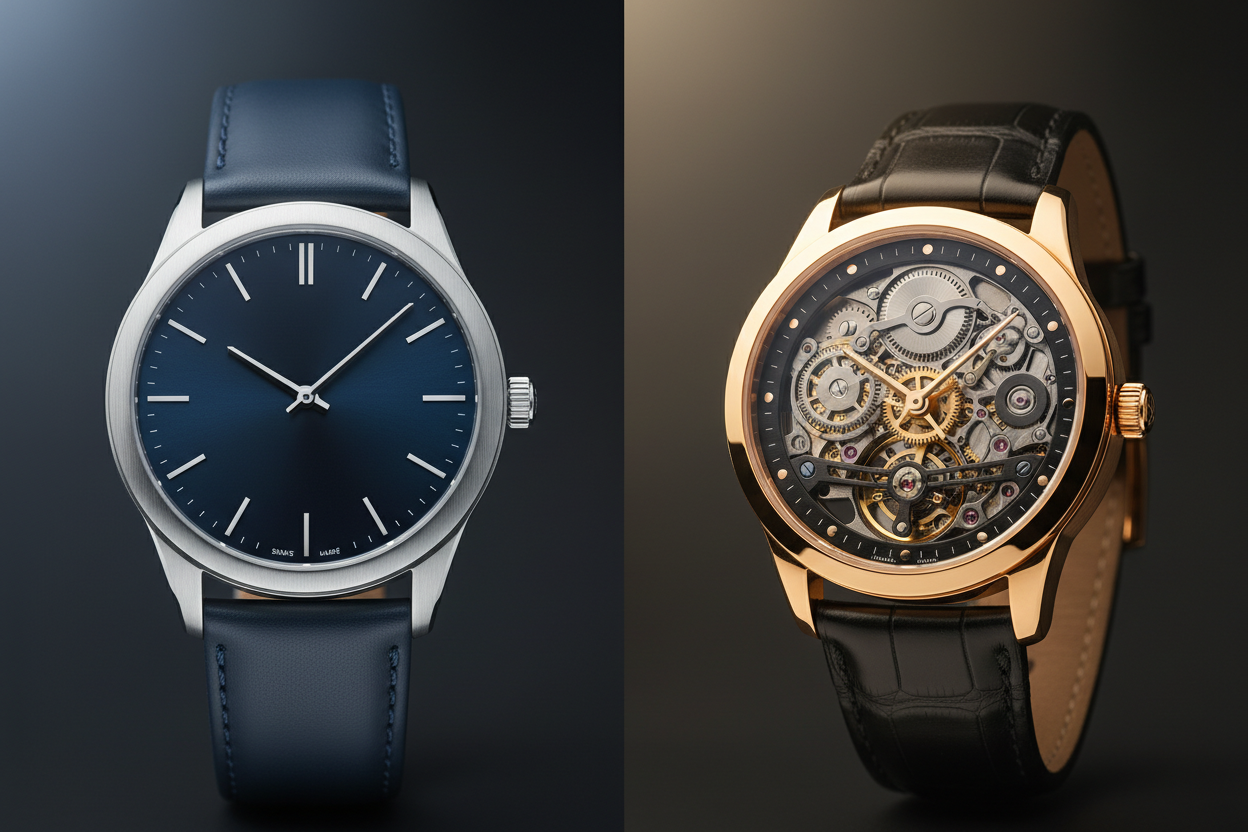
Watching the rotor move through an exhibition case back or seeing the smooth sweep of the second hand adds to that experience.
Cost
Quartz watches are generally more affordable because they are simpler to manufacture.
Automatic watches usually cost more due to the precision engineering and assembly required to produce hundreds of mechanical components that work together.
That does not mean one is inherently better than the other—it simply reflects different technologies.
Which One Should You Choose?
A quartz watch may be the better choice if you:
- Want maximum accuracy.
- Prefer minimal maintenance.
- Need a watch you can leave in a drawer for weeks and wear immediately.
- Are looking for an affordable everyday option.
An automatic watch may be the better choice if you:
- Appreciate traditional craftsmanship.
- Enjoy mechanical engineering.
- Like collecting watches.
- Want a timepiece that can be serviced for decades.
- Value the heritage of mechanical watchmaking.
Comparison Table
| Feature | Quartz Watch | Automatic Watch |
|---|---|---|
| Power Source | Battery | Wrist movement & mainspring |
| Accuracy | Extremely high | Very good, but less precise than quartz |
| Battery Required | Yes | No |
| Maintenance | Battery replacement | Periodic servicing |
| Seconds Hand | Usually ticks once per second | Smooth sweeping motion |
| Mechanical Complexity | Low | High |
| Collector Appeal | Moderate | High |
| Longevity | Excellent | Excellent with proper servicing |
Final Thoughts
Choosing between a quartz watch and an automatic watch is not about deciding which is objectively better.
It is about understanding what matters most to you.
If convenience and precision are your priorities, quartz is an excellent choice.
If you appreciate mechanical craftsmanship, engineering, and the tradition of watchmaking, an automatic watch offers an experience that goes beyond simply telling time.
The best watch is the one that fits your lifestyle while giving you confidence every time you glance at your wrist.