Swiss Watch Movements: Understanding the Heart of a Swiss Watch
When people look at a watch, they usually notice the dial, case, hands, bracelet, and finishing first. But beneath all of those visible elements is the component that gives the watch life: the movement.
For anyone considering a Swiss watch, understanding the movement is one of the most important parts of understanding what they are actually buying.
Swiss watchmaking is not built around a single movement, company, or technology. It is an ecosystem developed over centuries, ranging from traditional manual mechanical calibers to automatic movements, chronographs, GMT complications, high-precision quartz movements, and sophisticated manufacture calibers.
Names such as ETA, Sellita, Ronda, La Joux-Perret, Soprod, and Dubois Dépraz represent different chapters of that history.
A Tradition Built Over Centuries
Switzerland's reputation for watchmaking was not created by marketing alone.
For generations, specialized workshops throughout regions such as Geneva, Neuchâtel, the Vallée de Joux, Jura, and Grenchen developed expertise in producing the extraordinarily small components required for accurate timekeeping.
Wheels, pinions, escapements, mainsprings, bridges, and regulating systems eventually developed into an entire industrial ecosystem.
One particularly important part of this history is ETA. The origins of what eventually became ETA can be traced to early Swiss movement manufacturing during the eighteenth and nineteenth centuries. Over time, numerous specialized manufacturers became part of the structure that developed into modern ETA.
ETA — One of the Foundations of Modern Swiss Watchmaking
ETA has produced both mechanical and quartz movements and has supplied movement technology to a significant part of the Swiss watch industry.
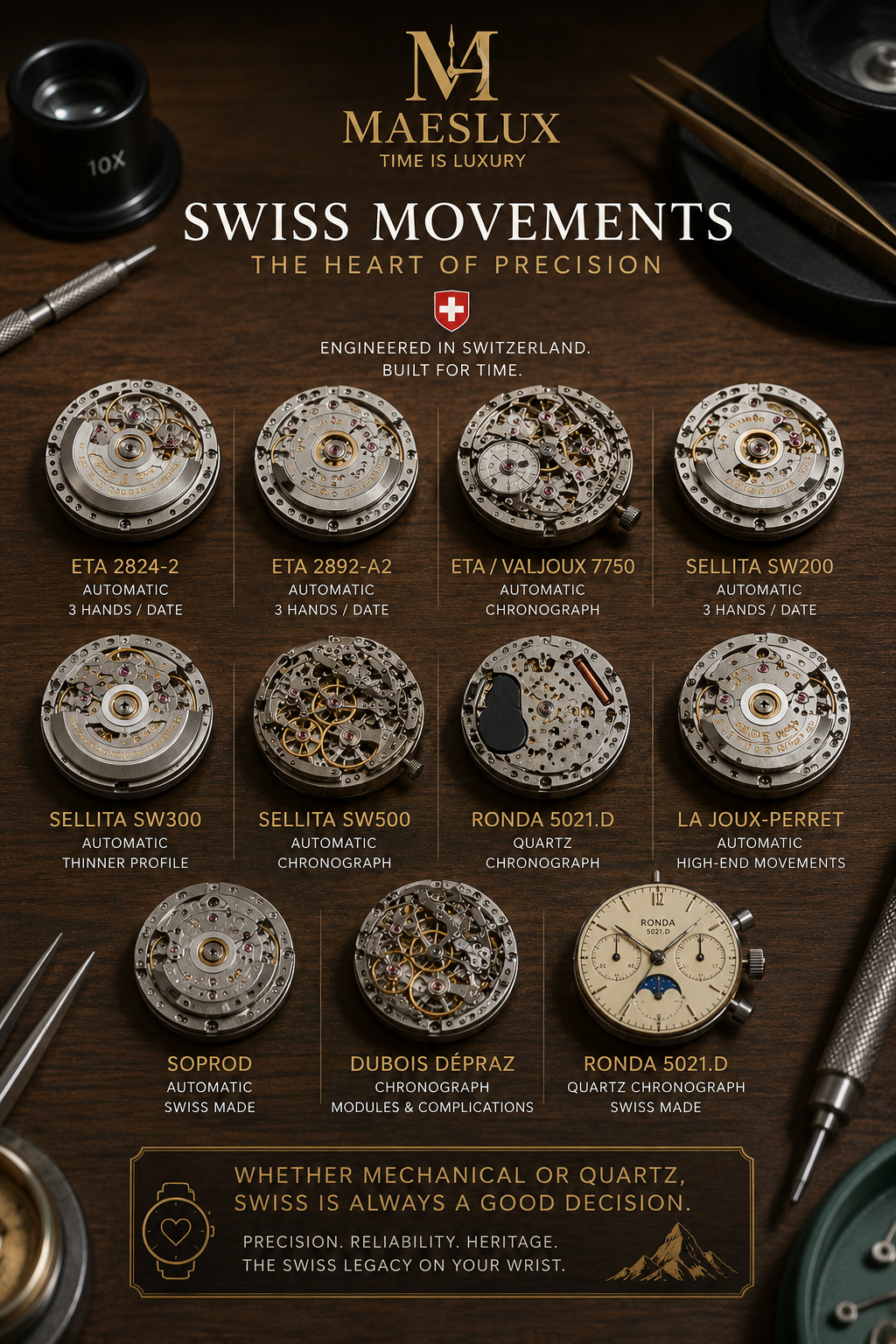
ETA 2824-2
The ETA 2824-2 became one of the most recognized Swiss automatic movements in modern watchmaking. It earned its reputation through a combination of reliability, serviceability, automatic winding, date functionality, and widespread familiarity among professional watchmakers.
Its architecture became a reference point for the modern Swiss automatic watch.
ETA 2892-A2
The ETA 2892-A2 represents a thinner and generally more refined movement architecture. Its relatively slim construction has made it useful in watches requiring elegant proportions or additional complications.
ETA / Valjoux 7750
Few mechanical chronograph movements have achieved the recognition of the Valjoux 7750.
Introduced during the 1970s, its architecture became one of the great workhorses of Swiss mechanical chronographs. Automatic winding, chronograph functionality, and proven construction helped make the 7750 and its descendants enormously influential.
Sellita — A Major Swiss Mechanical Movement Manufacturer
Sellita has become one of the most important independent suppliers of Swiss mechanical movements. Its movements are used by numerous watch brands around the world.
Sellita SW200
The SW200 family occupies a similar category to the historic ETA 2824 architecture. It is a compact automatic movement widely used in Swiss and international watches.
For many brands, the SW200 provides an excellent balance between proven mechanical engineering, serviceability, availability, and Swiss production.
Sellita SW300
The SW300 is thinner than the SW200 and is commonly selected when a watchmaker wants to create a slimmer or more refined automatic watch.
Its construction also makes it attractive as a base for watches incorporating additional complications.
Sellita SW500
The SW500 belongs to another category entirely: the automatic mechanical chronograph.
It follows the tradition of the famous Swiss automatic chronograph architecture associated with the Valjoux 7750.
A mechanical chronograph contains considerably more mechanical interaction than a conventional three-hand automatic watch, making movements such as the SW500 particularly interesting to watch enthusiasts.
Ronda — Swiss Quartz Engineering
There is a common misconception that a serious watch must always be mechanical. That is not correct.
Quartz and mechanical movements solve different problems and provide different experiences.
Swiss manufacturer Ronda has become an important producer of quartz movements used throughout the international watch industry.
Ronda 5021.D
The Ronda 5021.D is a Swiss quartz chronograph movement.
Where a mechanical chronograph emphasizes traditional mechanical construction, a Swiss quartz chronograph emphasizes accuracy, practicality, reliability, reduced maintenance, and chronograph functionality.
Quartz should therefore not automatically be considered inferior. It is simply a different technology designed for different priorities.
For someone who wants Swiss movement engineering combined with excellent everyday accuracy and convenience, a quality Swiss quartz caliber can be an excellent choice.
La Joux-Perret — Modern Swiss Movement Engineering
At a more specialized level sits La Joux-Perret, based in La Chaux-de-Fonds.
The manufacture develops mechanical movements and complications and represents another side of contemporary Swiss watchmaking.
Companies such as La Joux-Perret demonstrate an important principle: there is no single definition of what a Swiss movement must be.
Swiss movements can range from robust industrial calibers designed for larger production volumes to sophisticated movements developed for specialized and higher-end watches.
Soprod
Soprod is another important name within the Swiss movement industry.
It produces mechanical calibers and movement components, providing watch brands with additional alternatives within the Swiss mechanical ecosystem.
Its presence, along with manufacturers such as Sellita and La Joux-Perret, demonstrates why Swiss watchmaking should never be reduced to a single movement manufacturer.
Dubois Dépraz — Specialists in Complications
Some Swiss companies specialize not simply in conventional movements but in developing complications and movement modules.
One of the important historical names in this category is Dubois Dépraz.
The company became particularly important in the development of chronograph mechanisms and specialized modules used alongside base movements.
This represents another important dimension of Swiss horology: sometimes a sophisticated watch movement is the result of several highly specialized Swiss companies contributing their expertise.
The Swiss Quartz Revolution
Swiss watchmaking history also contains an important lesson about technology.
Switzerland played an important role in the early development of electronic quartz wristwatches. During the late 1960s and early 1970s, Swiss engineers developed important quartz technologies, including the famous Beta 21 project.
Japanese manufacturers later became extraordinarily successful at industrializing quartz watches, creating enormous pressure on the traditional Swiss mechanical watch industry.
During the 1970s and early 1980s, many Swiss manufacturers struggled or disappeared.
Switzerland eventually adapted. Mechanical watchmaking was repositioned around craftsmanship, engineering, heritage, and luxury, while Swiss quartz manufacturing continued developing alongside it.
Mechanical, Automatic, or Quartz: Which Is Better?
There is no responsible answer without first asking: better for what?
Manual Mechanical
In a manually wound mechanical watch, the wearer winds the mainspring by turning the crown. For enthusiasts, part of the appeal is the direct relationship between the owner and the mechanism.
Automatic Mechanical
An automatic movement uses an oscillating rotor that moves with the wearer's wrist and helps wind the mainspring.
Movements such as the Sellita SW200 and SW300 belong to this broad category.
Automatic Chronograph
Movements such as the Sellita SW500 combine automatic winding with a mechanical stopwatch mechanism.
The additional gears, levers, wheels, and components create significantly greater mechanical complexity.
Quartz
Quartz movements use electronic regulation and a quartz crystal to achieve extremely consistent timekeeping.
Quartz generally provides substantially greater accuracy than conventional mechanical movements.
Swiss manufacturers such as Ronda and ETA demonstrate that quartz technology can remain firmly within the tradition of Swiss watchmaking.
Swiss Movement Is Not the Same as Swiss Made
This distinction is extremely important.
A watch containing a Swiss movement does not automatically become a Swiss Made watch.
“Swiss Made” is a regulated designation with requirements extending beyond simply installing a Swiss movement.
Consumers should therefore understand the difference between:
- Swiss Movement
- Swiss Made Watch
They are not interchangeable statements.
A watch assembled outside Switzerland may contain a genuine Swiss movement. That can be an important technical advantage, but it does not automatically give the complete watch the legal designation “Swiss Made.”
Why Does a Swiss Movement Matter?
The importance of a Swiss movement is not simply the country printed on a specification sheet.
It is the industrial ecosystem behind it.
Swiss movement manufacturing has developed around generations of specialized knowledge in:
- Micro-mechanical engineering
- Escapement technology
- Precision manufacturing
- Movement regulation
- Mechanical chronographs
- Complications
- Finishing
- Testing
- Repair and servicing
This is one reason movements such as the SW200, SW300, SW500, ETA 2892, Valjoux 7750, and numerous Swiss quartz calibers continue to be respected throughout the watch industry.
Does Swiss Automatically Mean Expensive?
No.
A Swiss quartz chronograph and a sophisticated mechanical manufacture chronograph can both originate within the Swiss watchmaking ecosystem while occupying completely different price categories.
The value of a movement depends on far more than nationality.
Architecture, complications, materials, finishing, regulation, production volume, serviceability, and technical sophistication all matter.
The better question is not:
“Is this Swiss movement expensive?”
The better question is:
“What Swiss movement is inside this watch, and why was that particular caliber selected?”
Understanding What You Are Buying
A beautiful case can attract attention.
A dial establishes identity.
A bracelet changes how the watch feels on the wrist.
But the movement tells another important part of the story.
Someone comparing watches should look beyond the logo on the dial and ask:
- Who manufactured the movement?
- What caliber is being used?
- Is it mechanical or quartz?
- Can the movement be serviced?
- What complications does it provide?
- Is the complete watch Swiss Made or does it contain a Swiss movement?
Those questions transform someone from a casual shopper into a more informed watch buyer.
The Swiss Advantage Is Choice
Perhaps one of the greatest strengths of Swiss watchmaking is that there is no single Swiss movement.
There are movements designed for simplicity, thinness, diving watches, chronographs, GMT watches, precision quartz timekeeping, traditional mechanical watchmaking, and sophisticated luxury complications.
ETA, Sellita, Ronda, La Joux-Perret, Soprod, Dubois Dépraz, and Switzerland's manufacture movement specialists all occupy different positions within that ecosystem.
Understanding those differences allows someone to appreciate a watch for what it actually contains rather than judging it only by its price or logo.
Final Thought
Choosing a Swiss movement is not about believing that every Swiss caliber is identical or that nationality alone guarantees perfection.
It is about recognizing an ecosystem supported by centuries of accumulated watchmaking knowledge, specialized engineering, and technical experience.
From the dependable simplicity of a three-hand automatic movement, to the precision of Swiss quartz, to the mechanical complexity of an automatic chronograph, Switzerland continues to offer movements for nearly every level of watchmaking.
The movement is the heart of the watch. Understanding that heart is one of the best ways to understand what you are buying.
MAESLUX — Time is Luxury.