Is the Miyota 9015 a Good Movement? An Honest Deep Dive
If you've spent any time researching automatic watches under $1,500, one name keeps coming up in spec sheets: the Miyota 9015. It's inside watches from dozens of respected microbrands, it's praised by collectors on Reddit and YouTube, and yet a lot of buyers still ask the same question before pulling the trigger:
Is the Miyota 9015 actually a good movement, or is it just "good for the price"?
The short answer is yes it's genuinely good. The longer answer is more interesting, and it explains why we chose this caliber to power every Maeslux timepiece. Let's get into it.
What Is the Miyota 9015?
The Miyota 9015 is a Japanese-made automatic (self-winding) mechanical movement manufactured by Citizen's Miyota division. It was introduced in 2009 as Miyota's premium thin caliber, designed specifically to compete with mid-tier Swiss movements like the ETA 2824 and Sellita SW200.
Here are the core specifications:
- Type: Automatic, mechanical, self-winding
- Beat rate: 28,800 vibrations per hour (4 Hz)
- Jewels: 24
- Power reserve: Approximately 42 hours
- Thickness: 3.9 mm (notably thin)
- Functions: Hours, minutes, seconds, date, hand-winding, hacking seconds
- Stated accuracy: -10 to +30 seconds per day (real-world performance is usually much better)
The 9015 sits at the top of Miyota's range, well above the entry-level 8215 and 8200 series most people associate with budget mechanical watches.
So, Is the Miyota 9015 a Good Movement?
Yes and here's why that answer holds up under scrutiny.
1. Real-world accuracy beats the spec sheet
Miyota officially rates the 9015 at -10 to +30 seconds per day, which sounds wide. In practice, most properly regulated 9015 movements run within +5 to +10 seconds per day, and well-regulated examples often hit chronometer-grade performance (-4 to +6 spd) without any official certification.
That kind of accuracy is more than enough for daily wear. You'll need to set your watch maybe once a month, not once a week.
2. The 4 Hz beat rate matters
The 28,800 vph beat rate puts the 9015 in the same performance class as Swiss movements like the ETA 2824-2 and Sellita SW200. A higher beat rate means a smoother sweeping seconds hand and better timekeeping stability against shocks and position changes. The cheaper Miyota 8215, by comparison, runs at 21,600 vph noticeably less smooth and less stable.
3. It's genuinely thin
At 3.9 mm thick, the 9015 is one of the thinnest mass-produced automatic movements on the market. This is a big deal for watch design: it lets brands build elegant, slim cases that wear comfortably under a shirt cuff. Many bulky watches you've seen are bulky precisely because they use thicker movements.
4. Hacking seconds and hand-winding
The 9015 hacks (the seconds hand stops when you pull the crown), which lets you set the time to the exact second. It also accepts manual winding, so you can power it up after it's been sitting in a drawer without having to shake it for ten minutes. These two features are absent on the cheaper Miyota 8215, and their inclusion is one of the clearest signals that the 9015 is engineered for serious wear.
5. Reliability and serviceability
This is where the 9015 quietly excels. Miyota has been making mechanical movements for over 60 years, and the 9015 inherits decades of refinement. The movement is robust, parts are widely available, and almost any qualified watchmaker can service it. Compare this to some boutique in-house movements that require shipping the watch back to the manufacturer — a process that can take months and cost hundreds of dollars.
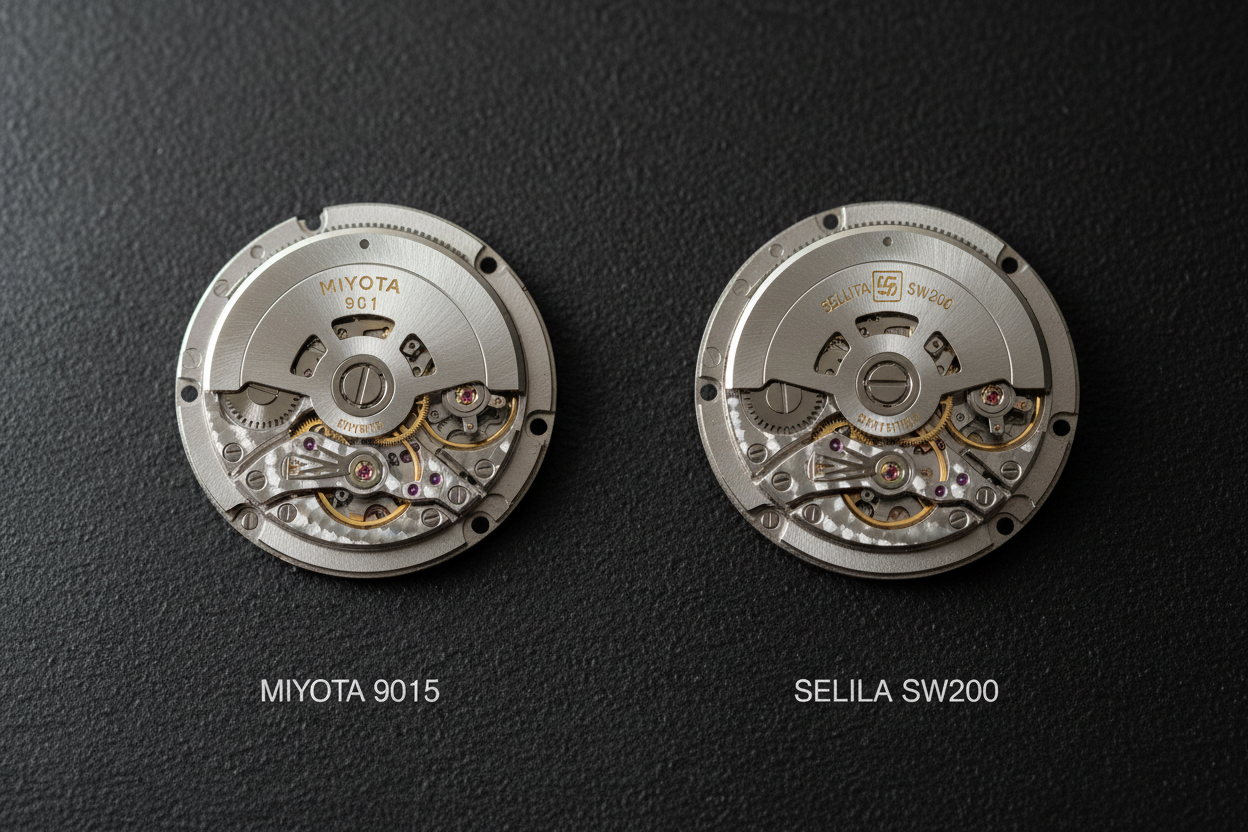
Miyota 9015 vs Sellita SW200: How Does It Compare?
This is the fairest comparison, since both movements target the same market segment.
| Feature | Miyota 9015 | Sellita SW200-1 |
|---|---|---|
| Origin | Japan | Switzerland |
| Beat rate | 28,800 vph | 28,800 vph |
| Power reserve | ~42 hours | ~38 hours |
| Thickness | 3.9 mm | 4.6 mm |
| Jewels | 24 | 26 |
| Hacking | Yes | Yes |
| Hand-winding | Yes | Yes |
| Typical accuracy (regulated) | +/- 10 spd | +/- 7 spd |
The Sellita has a slight edge in regulated accuracy and the prestige of being Swiss-made. The Miyota counters with better power reserve, a thinner profile, and — typically — lower cost, which lets brands invest more into the case, dial, and finishing rather than the movement alone.
For most buyers, the choice between these two movements should not be a dealbreaker. Both are excellent. What matters more is how the rest of the watch is built around them.
What Are the Downsides of the Miyota 9015?
Honest reviews need honest criticism. Here are the legitimate complaints:
- Rotor noise. Some 9015 units have a slightly audible rotor when you move your wrist. Not loud, but you can hear it in a quiet room. This is a known characteristic, not a defect.
- Off-center seconds hand. A small minority of 9015 movements show a tiny misalignment of the seconds hand with the minute markers. It bothers perfectionists; most people never notice.
- No "Swiss-made" cachet. If the word "Swiss" on a dial matters to you for status reasons, no Japanese movement will ever check that box. That's a personal preference, not a quality issue.
None of these are deal-breakers, and none affect timekeeping or longevity.
Why Maeslux Chose the Miyota 9015
When we designed the Maeslux Signature Collection, we made a deliberate choice: spend the budget where it shows on the wrist.
That meant pairing a proven, high-performance movement with materials and finishing that most brands at our price point cut corners on — 316L stainless steel, sapphire crystal with anti-reflective coating, and refined case work. The Miyota 9015 gave us the precision, slimness, and reliability our designs needed, without forcing us to compromise on the parts you actually see and touch every day.
If you're buying a watch you intend to wear for years, this is the right tradeoff.
Frequently Asked Questions
Is the Miyota 9015 better than the NH35?
Yes, in most measurable ways. The NH35 (Seiko) is a workhorse that runs at 21,600 vph and is thicker. The 9015 is smoother, thinner, and more accurate. The NH35 wins on absolute durability and lower cost, which is why it dominates entry-level dive watches.
How long will a Miyota 9015 last?
With basic care and a service every 5-7 years, a Miyota 9015 will easily last 20-30 years or more. Mechanical movements are designed to be maintained indefinitely.
Does the Miyota 9015 need a battery?
No. It's a fully mechanical automatic movement. It winds itself from the natural motion of your wrist. No battery, ever.
How often should I service a Miyota 9015?
Every 5-7 years for normal wear. If your watch starts losing or gaining significantly more time than usual, that's the signal it needs a service.
Can I wind a Miyota 9015 by hand?
Yes. Unscrew the crown (if it's a screw-down), and turn it clockwise about 20-30 times to give it a full charge. Then set the time and screw the crown back down.
The Bottom Line
The Miyota 9015 is one of the best values in modern watchmaking. It delivers Swiss-tier performance at a price that lets boutique brands like Maeslux build genuinely premium watches without inflating the final cost. If you see this movement listed in a watch's specs, take it as a sign that the brand prioritized real performance over marketing.
It's the engine we trust to power every Maeslux timepiece — and after reading this, we hope you understand exactly why.
Ready to see the Miyota 9015 in a watch designed without compromise?
Explore the Maeslux Signature Collection →