Titanium vs Stainless Steel Watches: Which One Is Right for You?
When choosing a fine watch, the case material is more than an aesthetic decision. It shapes how the watch feels on your wrist, how it holds up over time, and what it says about your priorities as a wearer. Two materials dominate the conversation in serious horology: titanium and stainless steel. Both are exceptional. But they are not the same.
Weight: The First Thing You'll Notice
Titanium is roughly 45% lighter than stainless steel at equivalent volume. For a daily wear piece, this difference is immediately felt. A titanium watch sits on the wrist with a presence that is almost imperceptible — there, but not demanding attention.
Stainless steel, by contrast, carries a satisfying heft. For many collectors, that weight is part of the experience — a physical reminder of what's on the wrist. It's a matter of preference, not performance.
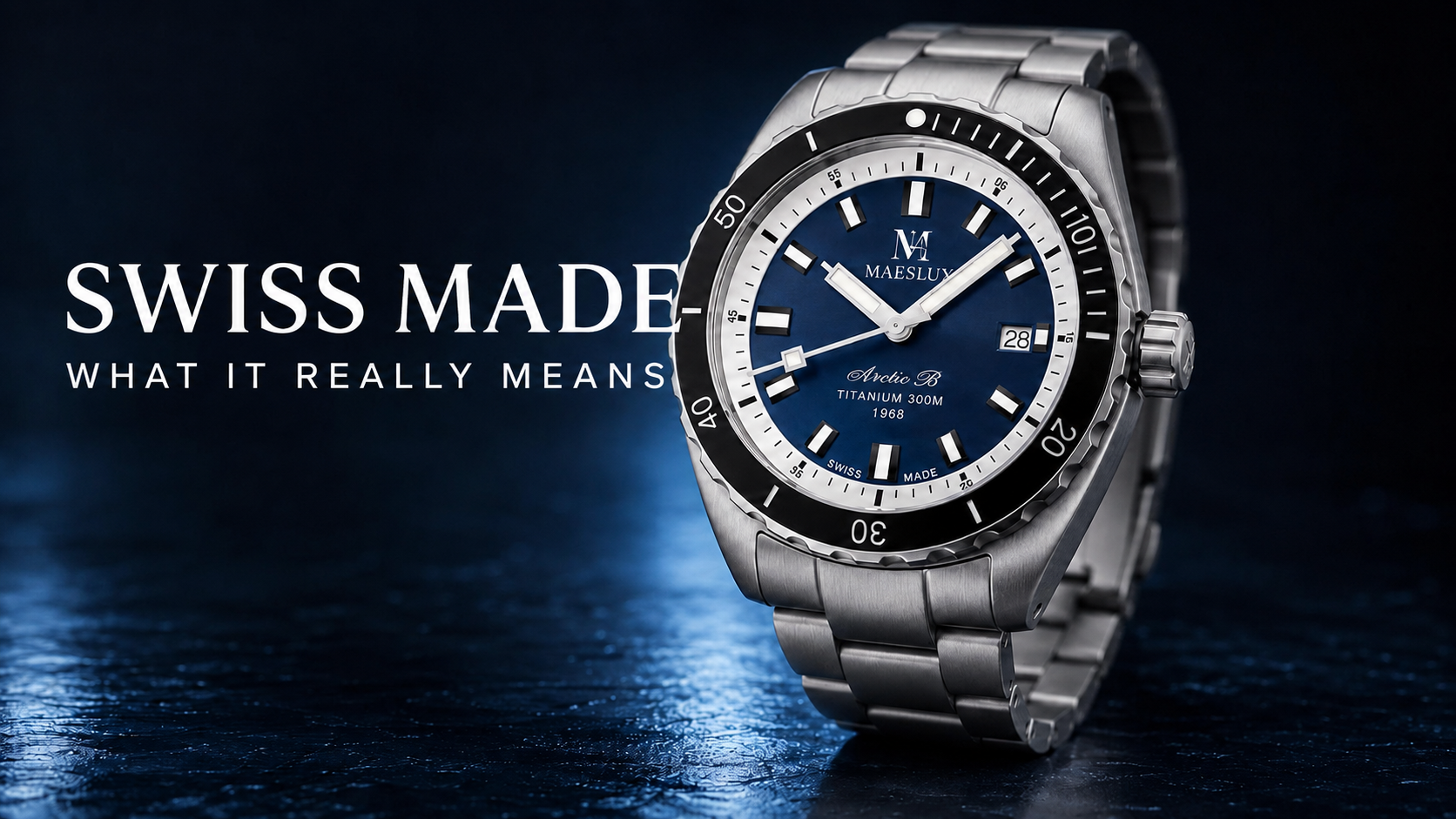
If you prefer the featherlight feel, the MAESLUX Arctic B Titanium is built precisely for that experience — Swiss-made precision in a case that disappears on the wrist.
Durability and Scratch Resistance
Here's where the conversation gets nuanced. Titanium is harder than steel in terms of tensile strength, but it is more prone to surface scratches in everyday use. The good news: titanium scratches tend to be shallow and can often be brushed out. Over time, a titanium case develops a natural patina that many wearers come to appreciate.
Stainless steel — particularly 316L or 904L grade — is more resistant to surface scratches and polishes to a mirror finish with ease. It's the reason steel remains the standard for dress watches and tool watches alike.
The MAESLUX Arctic and MAESLUX Arctic BK are crafted in stainless steel, offering that classic resilience and refined finish that holds up beautifully across years of wear.
Hypoallergenic Properties
Titanium is biocompatible — it's the same material used in surgical implants. For wearers with sensitive skin or nickel allergies, titanium is the clear choice. It will not react with skin, even during extended wear in warm conditions.
Most high-grade stainless steel used in watchmaking is also low in nickel content and generally well-tolerated, but titanium remains the gold standard for skin compatibility.
Corrosion Resistance
Both materials resist corrosion exceptionally well, but titanium has the edge in extreme environments. It is virtually immune to saltwater corrosion, making it a natural choice for dive watches and active wear.
The MAESLUX AN:DY Diver Automatic is engineered for exactly this kind of demanding use — a tool watch built to perform where conditions are unforgiving.
Aesthetics and Finishing
Stainless steel takes a polish exceptionally well, producing the high-contrast brushed and polished surfaces that define classic watch design. It's the material of choice when visual drama is the goal.
Titanium has a more muted, grey tone that lends itself to a modern, understated aesthetic. It doesn't shine the same way steel does — and that's precisely its appeal for those who prefer a quieter presence.
The CHRYS Blue Dial and CHRYS Black Dial in stainless steel demonstrate how the material elevates a dial — the contrast between case and dial is sharp, intentional, and enduring.
Price
Titanium is more expensive to machine than stainless steel. The material itself costs more, and the tooling required to work it precisely adds to production costs. This is reflected in the price of titanium watches — they command a premium that is earned, not arbitrary.
Stainless steel offers exceptional value at every price point, which is why it remains the backbone of Swiss watchmaking from entry-level to haute horlogerie.
The Verdict
There is no wrong answer — only the right watch for the right wearer.
Choose titanium if you prioritize low weight, hypoallergenic properties, and a modern aesthetic. Choose stainless steel if you value a classic look, superior surface finish, and proven durability across decades.
At MAESLUX, both paths lead to the same place: Swiss-made precision, uncompromising materials, and a timepiece built to outlast trends.